Blog
Someone Once Told Me I Wasn't Strategic Enough
Years ago, someone sat me down and told me I wasn’t strategic enough.
Not unkindly. They meant it as development. What I needed, they said, was to think at a higher level. More frameworks. A proper SWOT. Get the analysis right and the direction would follow.
I took it on the chin, because I was ambitious and I wanted to be taken seriously. So I went away and did exactly what I was told. Strengths, weaknesses, opportunities, threats. The competitor grid. A five year plan with phases in it and a colour scheme.
It was a lovely document. Genuinely one of the tidiest things I have ever produced.
And nothing changed. Not one thing.
The thing nobody tells you about the flipchart
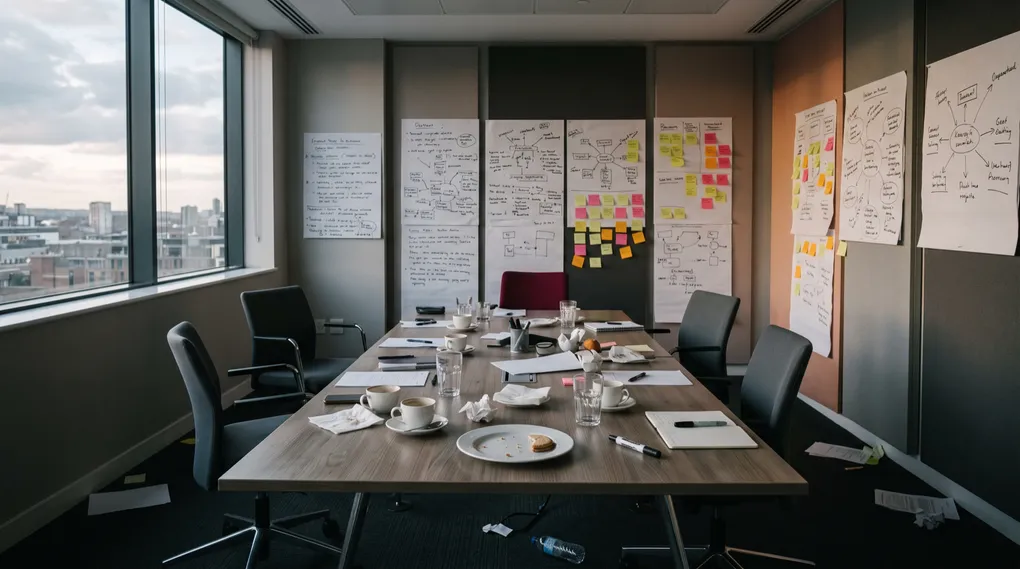
I have sat in a lot of strategy days since. Off-site venue, decent lunch, flipchart paper stuck to every wall by three in the afternoon. Everyone leaves feeling brilliant, and there is a real high to a day like that. I am not going to pretend otherwise.
Then Monday comes. The same three people are firefighting the same three things they were firefighting on Friday. The document goes in a folder. Six months later somebody asks where the strategy got to and there is an awkward silence.
The research backs this up and it is grim. Depending on whose numbers you read, well north of two thirds of well-made strategies fail, and not because the thinking was wrong. They fail in the gap between the plan and the people. One benchmark this year found that in most companies, staff could not name the top strategic priorities. Half of middle managers could not name a single one of the top five.
Read that again. Not disagreed with them. Could not name them.
That is not a strategy problem. That is a belief problem.
Frameworks describe. They never decide.
I came across a line recently from Dr Ian Hallett that I have not been able to put down. “Frameworks describe. They never decide.” He was replying to Dr Marc Sniukas, who writes about strategy properly and who put it just as plainly: execution is about people, not plans. A good plan changes nothing if people don’t believe in it.
That is the bit I was missing all those years ago. I thought strategy was an analysis problem, so I went and got better at analysis. It was never an analysis problem. It was an ownership problem.
Richard Rumelt makes the same point in Good Strategy Bad Strategy, and Roger Martin has spent a career on it in Playing to Win. Strategy is a set of choices about where you will play and what you will not do. Choices need someone to own them. A SWOT owns nothing. It sits there describing the weather.
So here is my stance, and I will hold it in any room you like. Strategy is not a document. It is a leadership capability. It lives in your people and your culture, or it does not live at all.
The three person test
If you want to know whether your strategy is real, you do not need a consultant or another away day. You need three people and ten minutes.
Pick three who were not in the room when the strategy was written. Not your senior team. Someone on the front line, someone in the middle, someone who joined this year. Ask each of them the same two questions, separately, and do not help them.
What are we trying to be brilliant at this year?
What have we decided to stop doing so we can be brilliant at it?
If you get three answers that broadly line up, you have a strategy. It is in the building, in people’s heads, shaping what they pick up on a Tuesday morning.
If you get three different answers, or worse, three polite versions of “not sure, I’d have to check”, then you do not have a strategy. You have a file. And no amount of new frameworks will fix that, because the framework was never the missing piece.
The second question is the one that catches people out. Most owners can tell you what they want to be great at. Almost nobody can tell you what they have given up to get there. If nothing has been dropped, nothing was chosen, and if nothing was chosen, there is no strategy. There is just a wish list with a nice cover.
What I would say to that person now
I would thank them, honestly. Not for the advice, which was wrong, but for the sentence. It nagged at me for years and it made me work out what I actually believed.
Being strategic was never about producing better documents. It is about making fewer, braver choices, then doing the slow human work of getting people to own them. That work is unglamorous. It is conversations, repetition, telling people the same thing until you are bored of your own voice, then telling them again. It does not photograph well on a flipchart. But it is the job.
Try the three person test this week. If the answers come back messy, that is not a failure, it is the most useful information you will get all month. If you want a second pair of eyes on what to do with it, grab half an hour with me.
So, be honest. If I asked three of your people what you have stopped doing this year, what would they say?